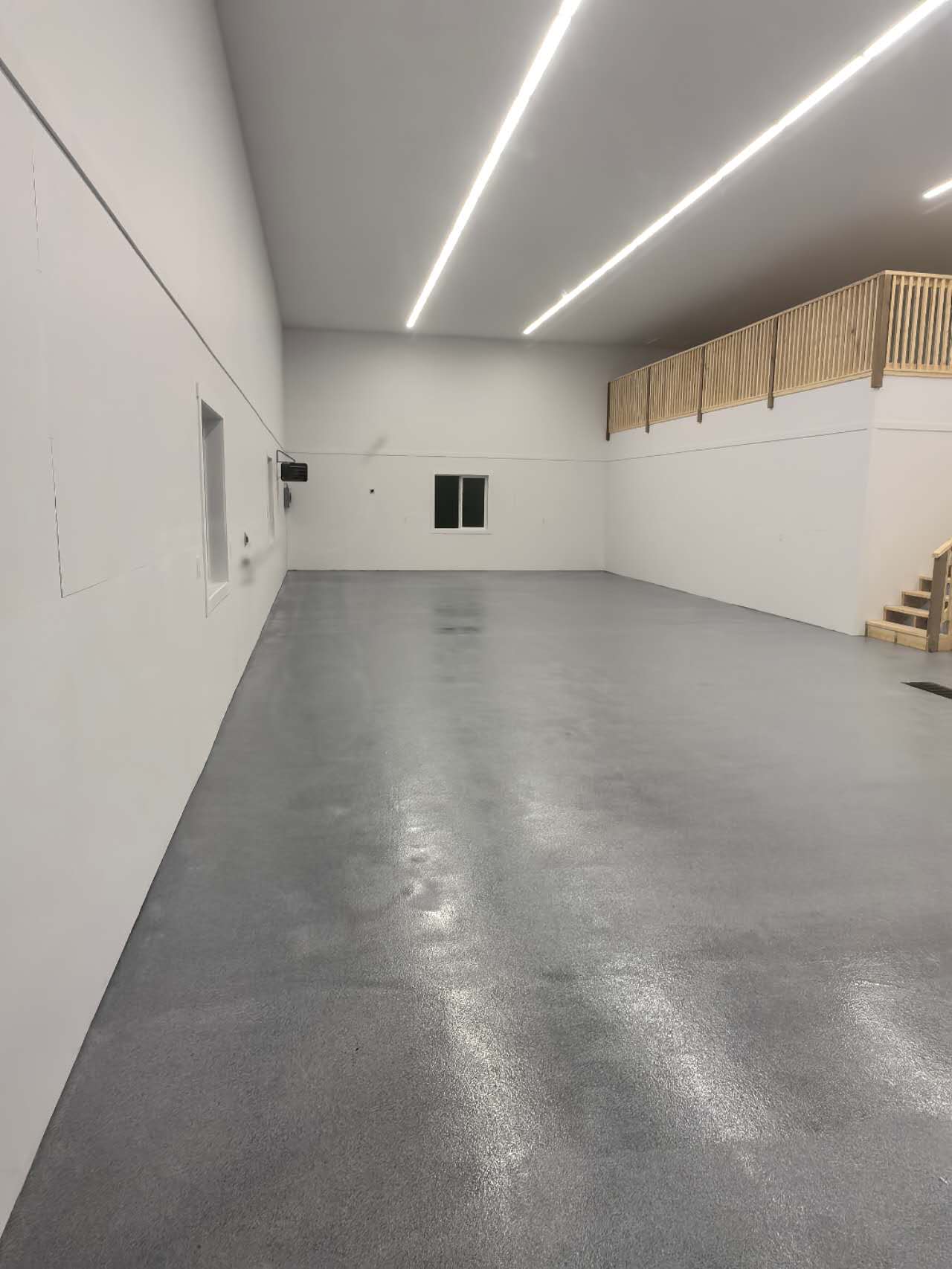
If your Vancouver business still has bare concrete, here's what that's actually costing you: cleaning time, chemical damage, dusty air, slip liability, and a floor that looks worse every month. Bare concrete is porous — it absorbs oils, spills, and bacteria. It sheds concrete dust that coats machinery and product. And every crack that goes unsealed gets bigger.
A proper commercial epoxy system doesn't just look better. It's a maintenance decision, a liability decision, and in food-service or healthcare settings, a regulatory decision. This guide gives you the full picture — no filler, no upsell.
By the time you finish reading, you'll know exactly what makes a commercial floor system worth the investment, which system fits your industry, what a professional installation looks like, and what to ask a contractor before you sign anything.
This guide is written specifically for Metro Vancouver conditions — BC moisture, freeze-thaw at ramp entrances, and BC health authority requirements for food service floors.
What Makes a System "Commercial Grade"?
The epoxy you buy at a big-box store is a single-component, solvent-diluted product with perhaps 40–60% solids by volume. When it dries, the solvents evaporate and you're left with a thin, brittle film. In a residential garage with light use, it might last a few years. In a commercial kitchen or warehouse, it fails in months — bubbling, peeling, cracking at joints.
A commercial-grade system is built differently:
- 100% solids content — no solvents evaporate, so you get the full film thickness you apply. At 20 mils wet, you get 20 mils dry.
- Multi-coat architecture — primer coat (penetrates and seals), body coat(s) with aggregate broadcast for thickness and texture, topcoat for UV stability and chemical resistance.
- Engineered hardener chemistry — different hardeners cure at different speeds, temperatures, and produce different final hardness ratings (Shore D scale). Commercial systems typically target 80–85 Shore D.
- Chemical resistance — commercial kitchens need resistance to degreasers, bleach, and hot water. Healthcare needs to withstand hospital-grade disinfectants. Warehouses need fork-lift tire resistance and fuel/oil exposure.
That's why a system specified for one environment can fail catastrophically in another. A decorative flake system that performs beautifully in a retail showroom is not appropriate for a commercial kitchen. Understanding system selection is the first thing that separates a knowledgeable contractor from a general painter with an epoxy bucket.
The 4 Commercial Systems You'll Actually Encounter
Most commercial epoxy conversations in Metro Vancouver fall into four system types. Here's an honest breakdown:
| System | Best For | Not Ideal For | Cost Tier | Return-to-Service |
|---|---|---|---|---|
| Epoxy Flake | Retail, showrooms, strata lobbies, garages | Food-service wet areas, heavy chemical exposure | $$ | 24–48 hrs light foot traffic; 72 hrs vehicle |
| Quartz Broadcast | Warehouses, industrial, commercial kitchens (sealed quartz) | Decorative applications where texture is a concern | $$–$$$ | 24–36 hrs foot traffic; 5–7 days full load |
| Urethane Cement | Food-service kitchens, breweries, cold storage, wet areas | Areas where texture is undesired; dry office environments | $$$$ | 16–24 hrs foot traffic; 3–5 days full production |
| Polyaspartic / Polyurea | Fast-turnaround projects, UV-exposed areas (ramp tops), retail | High-chemical environments (shorter pot life limits working time) | $$$ | 4–6 hrs foot traffic; 24 hrs vehicle |
Epoxy Flake Systems
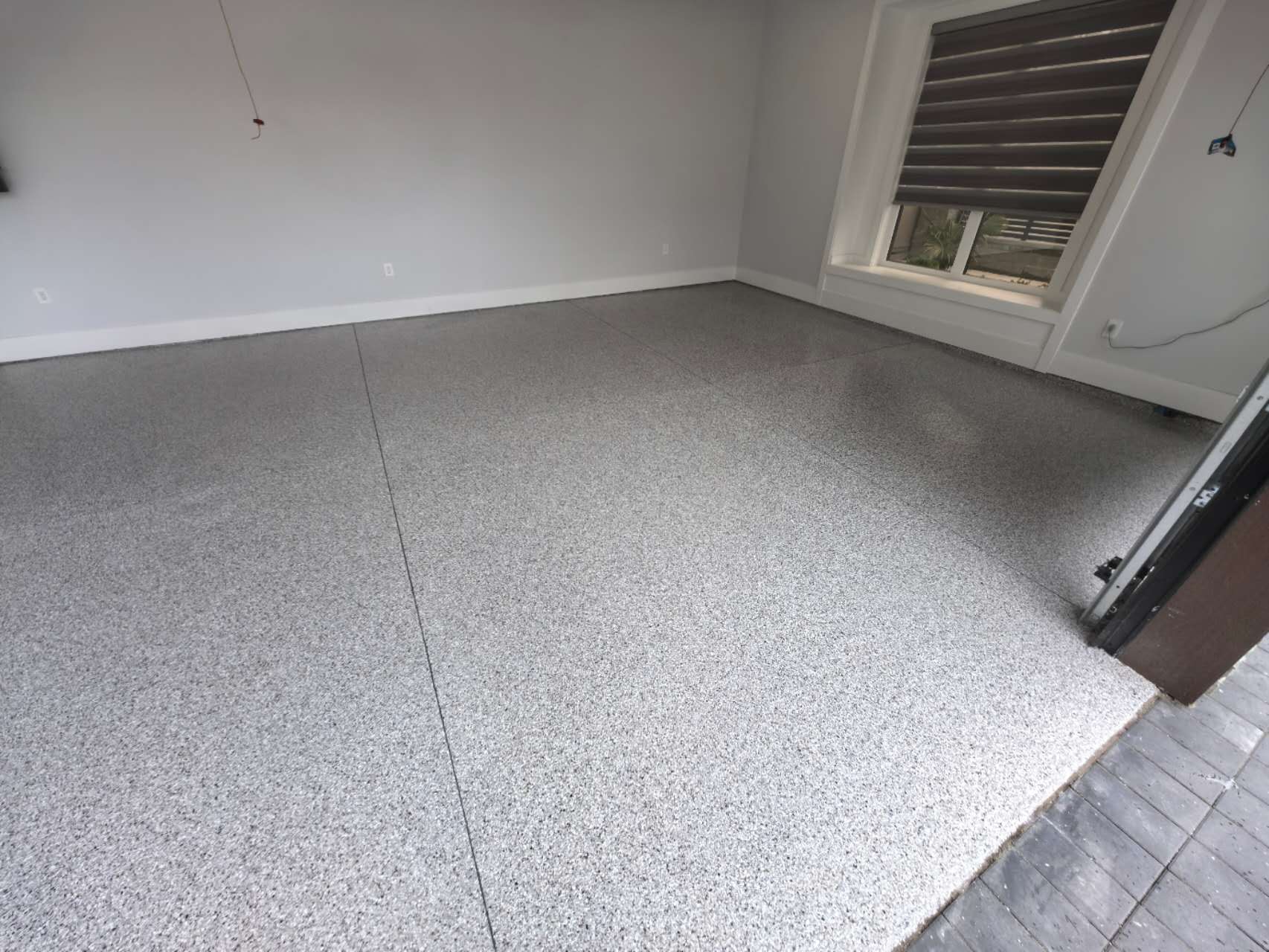
The most common commercial system in Metro Vancouver. A base coat is applied, vinyl flakes are broadcast (full or partial coverage), then sealed with one or two polyaspartic or polyurea topcoats. Excellent aesthetic versatility — dozens of flake blends available. The textured surface provides slip resistance. Not recommended for areas with standing water or aggressive chemical exposure without a very dense topcoat.
Quartz Broadcast Systems
Similar architecture to flake, but uses uniform-size quartz aggregate instead of flake. Produces a tighter, more industrial surface with higher compressive strength. Common in warehouses, food distribution, and manufacturing floors. Can also be used in commercial kitchens when sealed with a chemical-resistant polyurea topcoat.
Urethane Cement
The premium choice for food-service and wet-area applications. Urethane cement bonds chemically to concrete (not just mechanically), handles thermal shock (steam cleaning), resists acidic cleaning agents, and maintains anti-slip even when wet. Required by many BC health authority inspectors for commercial kitchen floors. It's more expensive and harder to apply — most contractors can't do it properly.
Polyaspartic / Polyurea Topcoats
Often used as a fast-cure topcoat over epoxy base coats rather than as a standalone system. Polyaspartic cures in hours, is UV-stable, and has good abrasion resistance. The short pot life means application must be fast and experienced. Increasingly used for parkades and outdoor-exposed areas where UV yellowing of standard epoxy is a concern.
By Industry: Which System Fits Your Business
Warehouse & Industrial
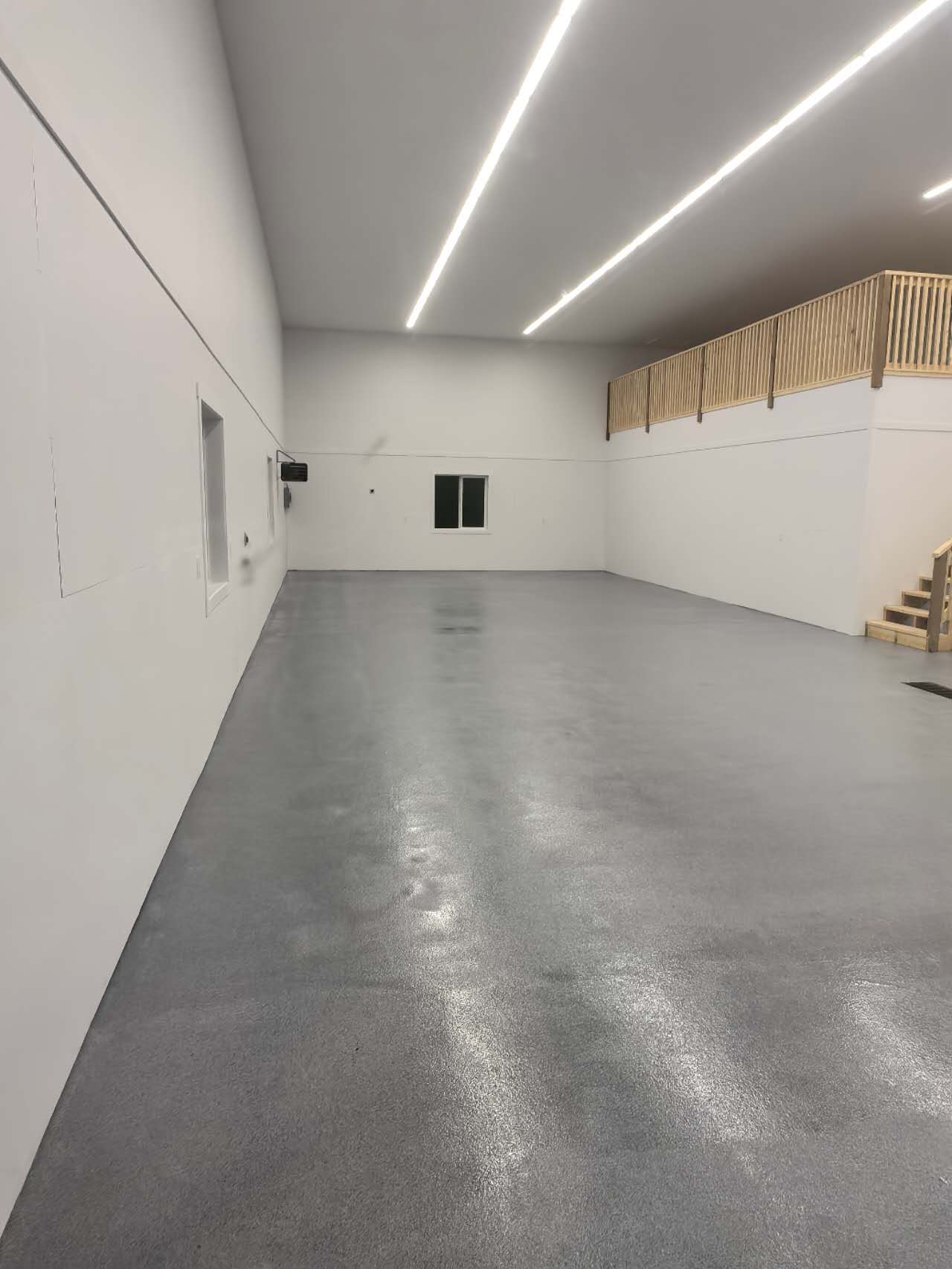
The primary concerns in a warehouse are impact resistance (dropped pallets, heavy machinery), fork-lift traffic (tire marks, hydraulic fluid spills), and dust control. A quartz broadcast or heavy flake system at 60–80 mils total thickness is typically the right specification. Coved bases are recommended where floors meet walls to eliminate the dirt trap at the joint. We also install MVB (moisture vapour barrier) primers in warehouses near grade — BC's wet climate means elevated slab moisture is common year-round.
Project example: Our Burns Lake warehouse used a full-broadcast quartz system with two polyaspartic topcoats. The client had previously dealt with constant concrete dust contaminating product packaging — that problem disappeared immediately after install.
Restaurant & Kitchen
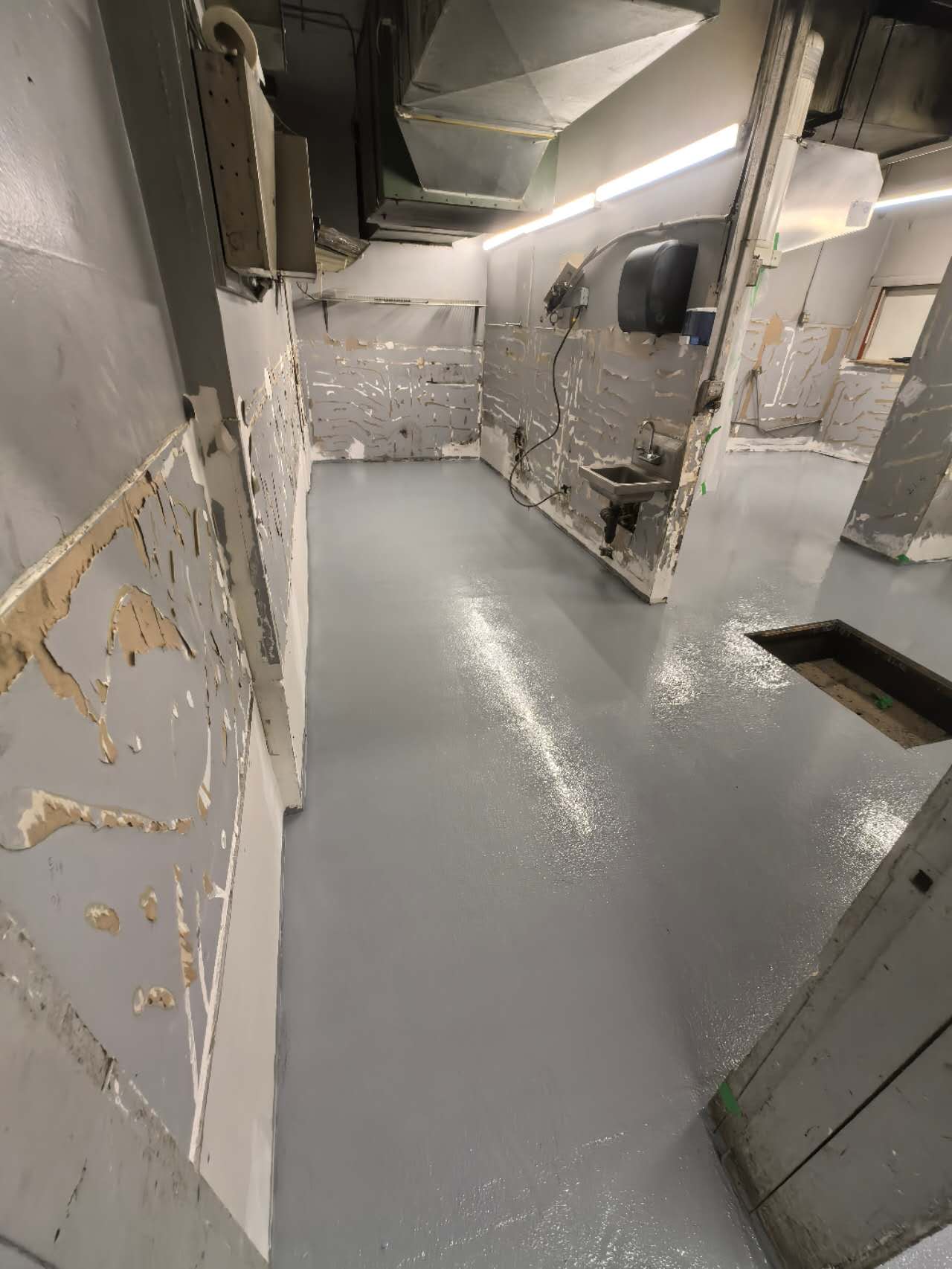
Commercial kitchens have the most demanding flooring requirements of any civilian environment: continuous hot water exposure, grease, acidic cleaning chemicals, thermal shock from steam equipment, slip risk, and BC health authority inspection standards. The only appropriate system is urethane cement, or a tightly sealed quartz broadcast with a chemical-resistant polyurea topcoat (and understanding that the polyurea must be maintained and eventually recoated).
Anti-slip aggregate must be embedded — CFIA and BC health authority require a minimum coefficient of friction for commercial kitchen floors. We always specify profiles that meet or exceed those standards. Drains need to be properly sealed and coved around their perimeter. Floor-to-drain slope must be maintained in the coating — this requires a skilled application team.
Healthcare & Institutional
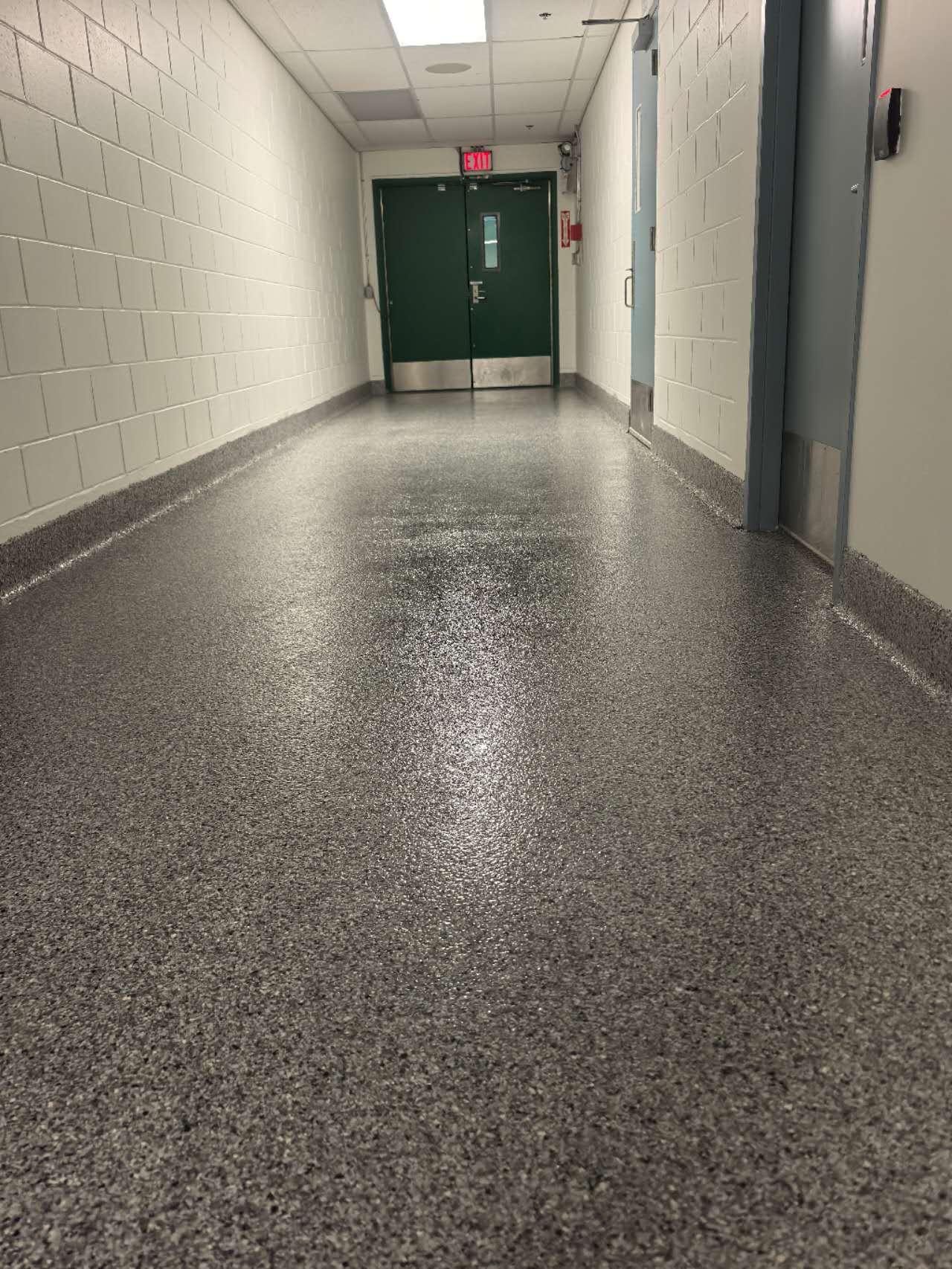
Government facilities, clinics, and healthcare spaces require seamless, non-porous floors that can withstand hospital-grade disinfectants (bleach, quaternary ammonium, hydrogen peroxide) without degrading. The seamless quality of epoxy is a genuine advantage here over tile (no grout joints to harbour bacteria). A 100% solids epoxy broadcast system with an antimicrobial additive and chemical-resistant topcoat is the standard specification. Colour-coding of floor areas is also common in institutional settings — epoxy can achieve this cost-effectively.
Strata Parkades & Parking Structures
Parkade flooring in Metro Vancouver faces a unique combination of stressors: tire traffic, vehicle fluids, road salt tracked in from winter roads, and freeze-thaw cycling at ramp entrances. Standard epoxy yellows under UV exposure at ramp tops and fails at cold-exposed sections. The correct system is a polyurea or polyaspartic topcoat over a penetrating epoxy primer. For full-deck applications with structural crack bridging requirements, a polyurethane membrane may also be appropriate. Coved bases and drain sealing are essential.
The Vancouver Factor
Generic flooring articles written for dry-climate markets will miss several factors that directly affect commercial epoxy performance and specification in Metro Vancouver:
Moisture from BC Rain and Snowmelt
Vancouver averages over 1,150 mm of rain per year — most of it concentrated from October to April. This means concrete slabs in lower-grade buildings, garages, and food-service spaces often carry elevated moisture vapour emission rates (MVER). If epoxy is applied over concrete with MVER above 5 lbs/1,000 sq ft/24 hours without a moisture vapour barrier primer, the coating can delaminate within 12–18 months regardless of application quality. Any professional working in Vancouver should automatically include a moisture test and, where needed, specify an MVB primer. Ask your contractor: what MVER reading triggers an MVB spec? If they don't know the number, that's a red flag.
Freeze-Thaw at Ramp Entrances
Parkade ramp entrances and partially-exposed loading docks cycle through freeze-thaw conditions during Vancouver winters. Standard epoxy systems are not designed for this — they crack and delaminate as the concrete substrate expands and contracts. The correct fix is a flexible polyurea system with elongation-rated chemistry, or a hot-applied rubberized membrane at the cold-exposed zone. This isn't an upsell — it's the difference between a floor that lasts 3 years and one that lasts 15.
BC Health Authority Requirements
For food service businesses, the BC Centre for Disease Control and regional health authorities (Fraser Health, Vancouver Coastal Health, Interior Health) publish inspection standards that address floor surface materials. Key requirements include: impermeable surfaces, non-toxic materials, cleanable to a sanitary condition, and anti-slip texture in wet-work areas. Epoxy systems meet these standards — but only if installed correctly. A delaminating or cracked epoxy floor will fail inspection faster than the bare concrete it replaced.
What to Expect: The Installation Process
Understanding what a professional installation involves is the single best way to evaluate whether a quote is realistic — and whether a contractor is cutting corners.
Step 1: Site Assessment & Moisture Testing
Before any quote is finalized, we measure the space, document existing floor conditions (cracks, contamination, previous coatings), and test for moisture vapour emission. This is non-negotiable. MVER testing takes about 24–72 hours using calcium chloride or Relative Humidity probes. Any contractor quoting without a site visit is guessing.
Step 2: Surface Preparation
The most labour-intensive phase — and the most important. We use diamond grinding or shot blasting to mechanically profile the concrete (typically CSP 3–5 depending on the system). This opens the pores for chemical bonding and removes contamination. Cracks are routed and filled with polyurea crack filler. Spalled sections are rebuilt with epoxy mortar. This phase alone can represent 40–60% of total labour cost on a commercial project.
Step 3: Moisture Vapour Barrier Primer
Applied if MVER testing indicates elevated moisture. Penetrates deeply, chemically reacts with concrete to form a waterproof layer. Must fully cure (typically 12–24 hours) before the body coat can go down.
Step 4: Body Coat & Broadcast
The main epoxy or urethane cement layer is applied. Aggregate (flake, quartz, or sand) is broadcast to rejection. Surplus is swept and vacuumed once cured. Timing between coats must be respected — recoat windows vary by product and temperature.
Step 5: Topcoat(s)
One or two topcoats of polyaspartic or polyurea seal the aggregate, provide the final gloss level, and deliver chemical and abrasion resistance. Some systems get two topcoats for high-traffic or high-chemical-exposure environments.
Step 6: Cure & Return-to-Service
Return-to-service timelines depend on the system and temperature. Most commercial systems are foot-traffic ready in 24–48 hours. Full vehicle/forklift traffic typically requires 5–7 days. Food-service kitchens using urethane cement can often resume operations in 16–24 hours for foot traffic, though full production loads should wait 72 hours.
On downtime: For most commercial spaces, we phase the work by section. Half the floor one night, the other half the next — keeping your business running throughout. Full closures are only required when the entire floor is a single system (e.g., seamless commercial kitchen).
How Much Does Commercial Epoxy Cost in Vancouver?
Below are real Metro Vancouver price ranges. These are installed costs including prep, materials, and labour:
| System Type | Price Range (per sq ft) | Notes |
|---|---|---|
| Epoxy flake (standard) | $5 – $9 | Most common commercial system |
| Quartz broadcast | $8 – $12 | Warehouses, industrial, food distribution |
| Urethane cement | $12 – $18 | Commercial kitchens, wet areas, cold storage |
| Polyaspartic/polyurea (fast-cure) | $7 – $11 | Parkades, retail, UV-exposed areas |
Factors that move prices up: significant crack repair, contamination remediation, MVB requirements, complex drains, phased installation to maintain operations, and premium topcoat products. Factors that move prices down: large total area (economies of scale), clean slab condition, simple rectangular layout with no obstacles.
For a detailed cost breakdown by residential and commercial square footage, see our Vancouver Epoxy Flooring Cost Guide.
How to Choose the Right Commercial Contractor
The most important decision in a commercial epoxy project isn't the system — it's who installs it. A great system applied poorly fails. A modest system applied with proper prep and technique will outlast a premium system applied carelessly. Here are the seven criteria that matter:
A contractor who bids low and skips prep will cost you more than one who bids correctly the first time. The floor that fails in 18 months costs twice: once to install, once to remediate.
Frequently Asked Questions
How long does a commercial epoxy floor last?
A properly installed commercial epoxy system can last 20+ years. In very high-traffic environments — warehouses, commercial kitchens, parkades — a maintenance recoat is typically needed at the 7–10 year mark. This is normal planned maintenance, not a failure, and costs a fraction of the original installation. Our installations come with a 5-year warranty.
Can epoxy be applied over existing paint or coatings?
Rarely without remediation. Existing coatings must be tested for adhesion, and most need to be mechanically removed before a new system goes down. Applying epoxy over a failed coating is one of the most common causes of premature delamination. A site assessment will determine what's underneath and what prep is needed.
What's the minimum temperature for epoxy application?
Most epoxy systems require substrate and ambient temperature of at least 10°C (50°F), with humidity below 85%. In Vancouver's shoulder seasons (November–March), we use low-temperature-rated hardeners and may stage work in shorter windows to maintain proper cure conditions. Urethane cement systems are somewhat more tolerant of moisture but still have minimum temperature requirements.
Will my business need to close during installation?
For most commercial projects, we can phase the work by section — keeping part of your floor operational while we coat the rest. Full closures are only necessary when the entire floor must be treated as a single system (e.g., seamless food-service kitchens). We schedule around your operations and can work nights or weekends to minimize downtime.