The honest answer to "how much does epoxy flooring cost?" is: it depends. But that answer is only useful if you understand what it depends on — so here are real numbers first, followed by exactly what moves those numbers.
Quick Price Summary — Metro Vancouver
These are installed prices including surface preparation, materials, and labour. They reflect what professional contractors in Metro Vancouver are actually charging in 2026:
| System Type | Residential | Commercial |
|---|---|---|
| Standard flake epoxy | $4.50 – $7 / sq ft | $5 – $9 / sq ft |
| Quartz broadcast | $7 – $10 / sq ft | $8 – $12 / sq ft |
| Metallic epoxy | $9 – $14 / sq ft | — |
| Polyaspartic / polyurea (fast-cure) | $6 – $9 / sq ft | $7 – $11 / sq ft |
| Urethane cement | — | $12 – $18 / sq ft |
If you're a skimmer, that table is your answer. If you want to understand what puts you at the high or low end — and how to avoid paying for a floor you'll have to redo in two years — read on.
What Drives the Price Up or Down
Floor Condition
This is the biggest variable that most quotes don't make transparent. A clean, flat, uncontaminated concrete slab needs basic diamond grinding and crack filling. A contaminated slab (oil, grease, previous coating, efflorescence) requires additional prep steps — shot blasting, degreasing, or full coating removal. Each of these adds time and cost.
Significant crack repair also adds cost. Hairline cracks get polyurea filler; structural cracks (wider than 1/8") may require routing, filling, and a bridging membrane. Spalled or pitted areas need epoxy mortar topping. None of this is unusual — it's just honest prep that cheap quotes skip.
System Type and Coat Count
More coats mean higher material and labour cost, but also longer lifespan and better performance. A single-broadcast flake system with one topcoat is entry-level. A two-topcoat polyaspartic system over a heavily broadcast base will cost more but lasts years longer in high-traffic environments. Don't compare quotes unless you know what system each one specifies.
Total Area (Economies of Scale)
The math generally gets better as the job gets bigger. Mobilization cost (getting equipment, materials, and crew to the site) is largely fixed. A 500 sq ft floor absorbs that cost differently than a 5,000 sq ft floor. As a rough guide, jobs over 2,000 sq ft start to see meaningful per-square-foot savings. Warehouse-scale jobs (10,000+ sq ft) can come in well below the residential rate per foot for equivalent systems.
Moisture Vapour Barrier Requirement
In Metro Vancouver, elevated slab moisture is common — especially in concrete poured before modern vapour barrier standards, or in buildings near grade. If moisture testing (calcium chloride or RH probes) shows elevated MVER, a moisture vapour barrier (MVB) primer must be applied before the main system. MVB primers add $1.50–$2.50/sq ft to the job. This isn't optional — skipping it on an elevated-moisture slab guarantees delamination.
Access and Logistics
Tight stairwells, underground parkades without freight elevator access, areas requiring evening or weekend scheduling, and occupied buildings with active business operations all add logistical complexity and cost. A straightforward residential garage is the simplest scenario. A phased commercial installation around an operating restaurant is the most complex.
Residential Pricing Breakdown
Garage Floors
The most common residential job. For a single-car garage (~200–250 sq ft), expect $900–$1,400 installed. A standard 2-car attached garage (roughly 400–480 sq ft) typically runs $1,800–$2,800 — the same figures confirmed in our FAQ. This includes diamond grinding, crack repair, and two topcoat passes. Homes with significant oil contamination or heavily cracked slabs may run closer to the upper end.
Basement Floors
Basements frequently have moisture concerns due to below-grade conditions. Moisture testing is especially important here. Expect to add $1.50–$2.50/sq ft if an MVB primer is needed. For a finished basement of 800–1,000 sq ft, budget $3,600–$8,000 depending on system and condition. The range is wide because condition variability is high with basements.
Metallic Epoxy
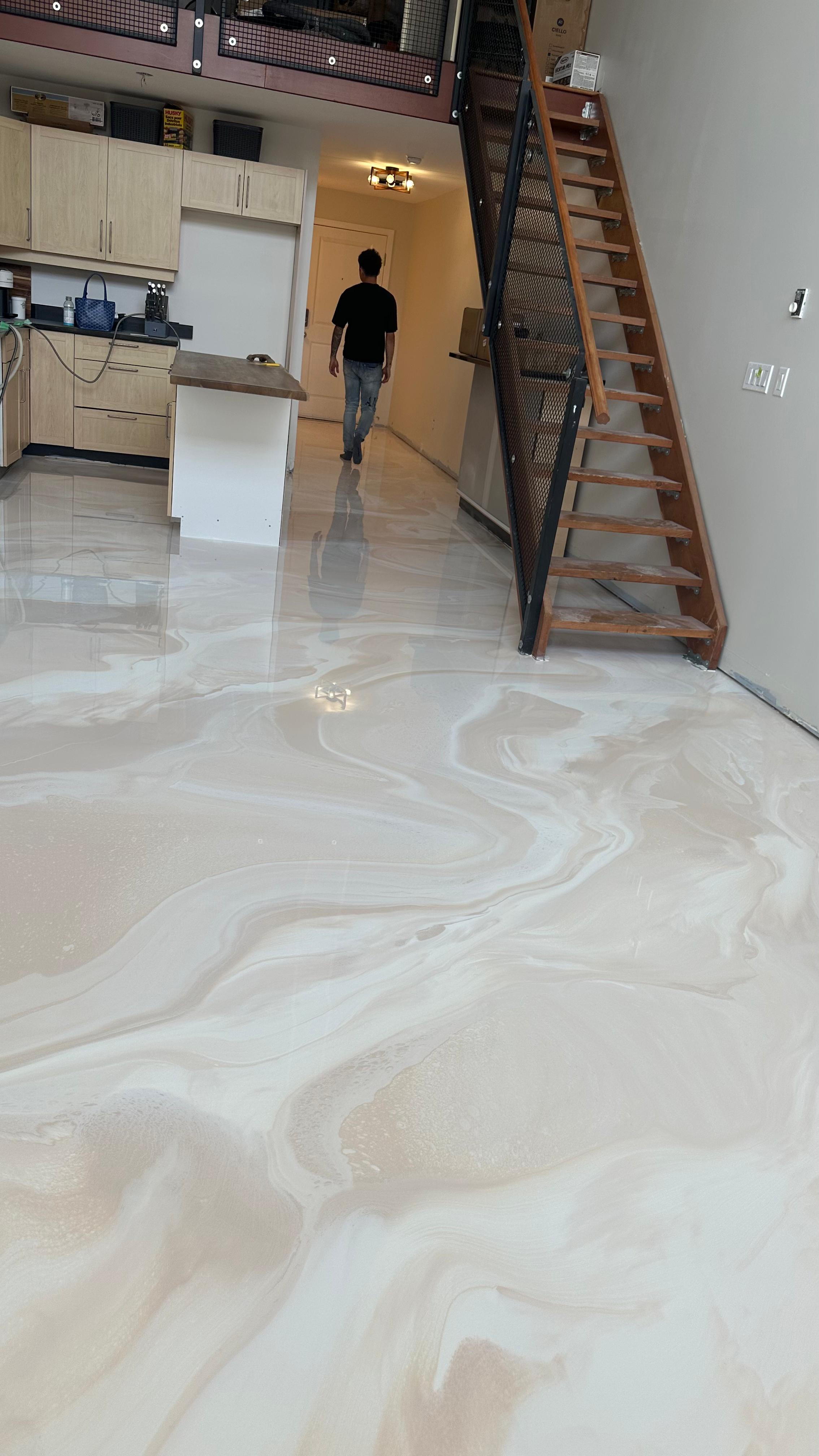
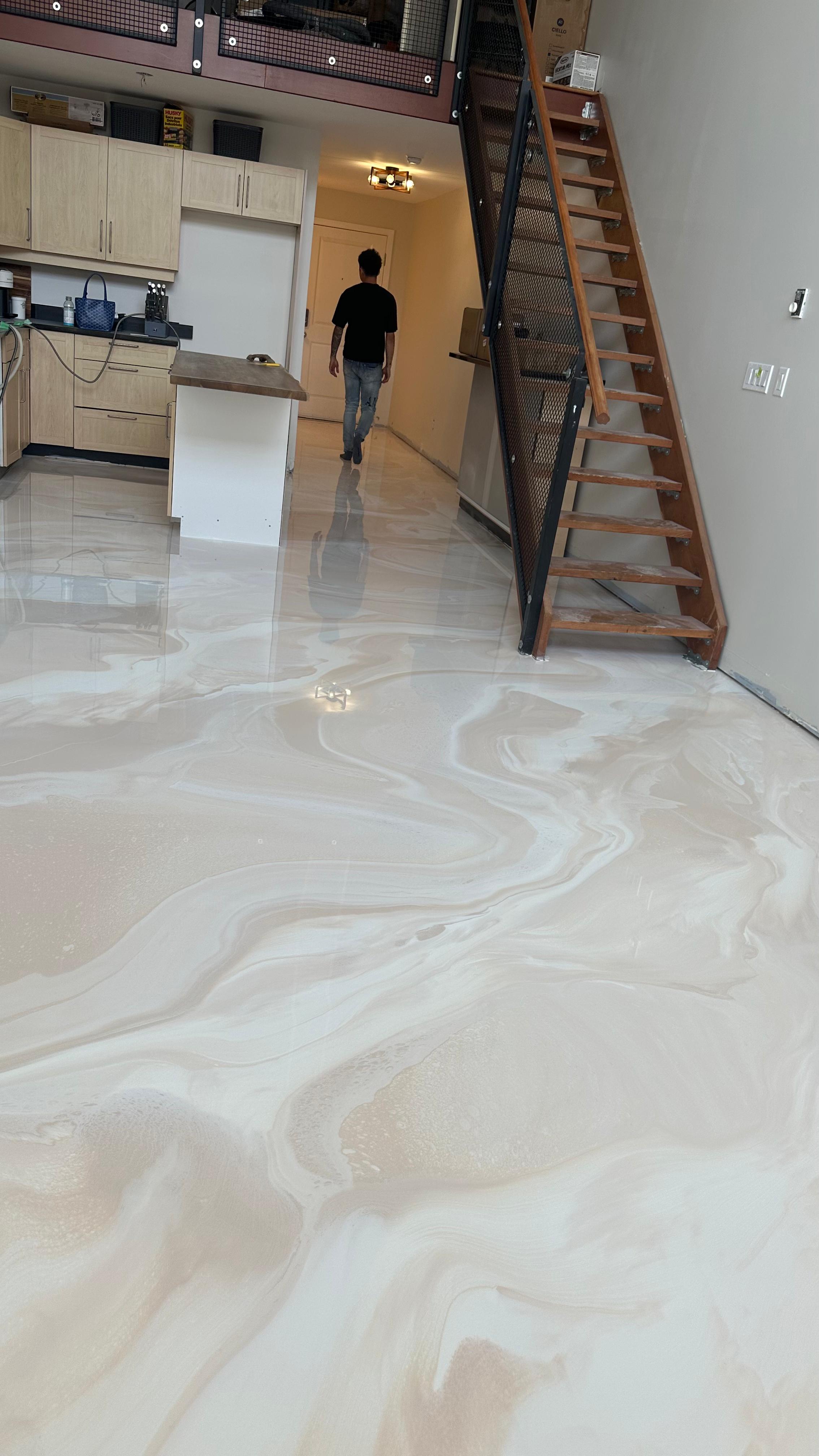
The premium residential option. Metallic epoxy creates a distinctive marbled, three-dimensional appearance that works exceptionally well in showrooms, luxury garages, and high-end home gyms. The system requires a skilled application team — metallic pigments are manipulated wet to create the pattern, which is an art as much as a trade skill. Expect $9–$14/sq ft for professional metallic installations in Metro Vancouver.
Commercial Pricing Breakdown
Small Retail (under 1,000 sq ft)
For a small retail space or showroom, a flake or quartz broadcast system runs $5–$9/sq ft installed. The premium for commercial over residential is partly driven by scheduling (typically after-hours or weekends) and the additional liability/insurance requirements. A 600 sq ft retail floor budget: $3,000–$5,400.
Restaurant Kitchen
Commercial kitchens require urethane cement or a tightly sealed quartz system — both at the higher end of the commercial range. Budget $12–$18/sq ft for a code-compliant food-service floor. A 400 sq ft commercial kitchen: $4,800–$7,200. This is more expensive per foot than an office floor, but the performance requirements (chemical resistance, thermal shock, anti-slip) justify the system.
Warehouse at Scale
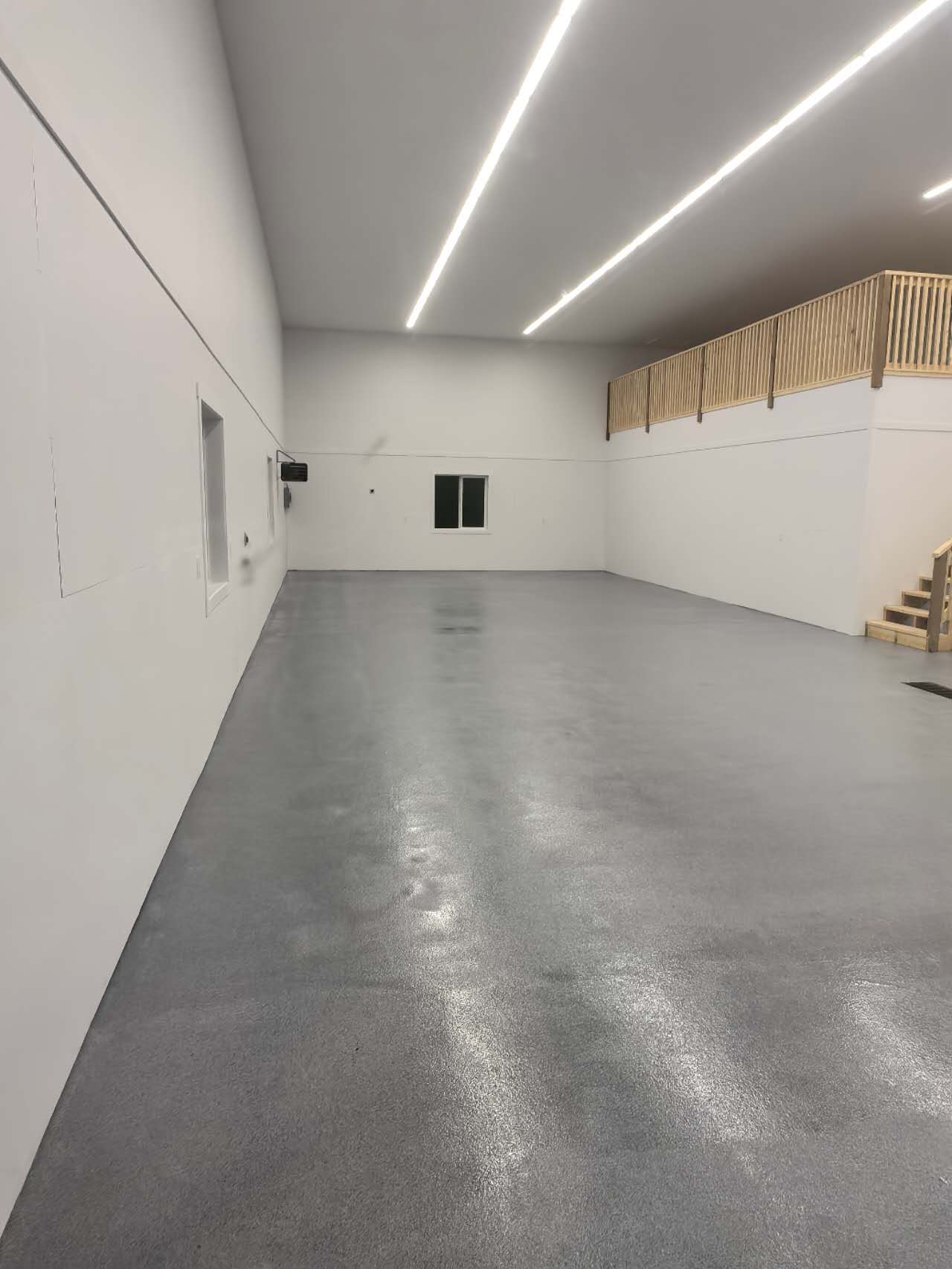
Large warehouse jobs (5,000+ sq ft) benefit significantly from economies of scale. A quartz broadcast system on a 10,000 sq ft warehouse in good condition can be installed for $7–$10/sq ft — bringing the total to $70,000–$100,000. That sounds like a lot until you consider the floor will last 10–15 years with no major maintenance and eliminates the ongoing cost of concrete dust, oil absorption, and floor deterioration.
The Cheap Epoxy Problem
Here's the math that most people don't do until after the fact:
A $2/sq ft epoxy job on a 500 sq ft floor costs $1,000. If it delaminates at 18 months (and sub-$3/sq ft installs frequently do), you're back to bare concrete. Now you need to grind off the failed coating — which adds remediation cost — and reinstall. Total cost over 3 years: $3,000–$4,000. A professional install that lasts 10 years at $5/sq ft costs $2,500 once, plus nothing for 10 years. Total cost over the same 3 years: $2,500.
The cheap option costs more. Every time.
Why Cheap Installs Fail
Solvent-based epoxy (the most common product in low-cost kits and cut-rate installs) evaporates solvent during cure, leaving a thinner, more brittle film than the wet coat suggests. The film also remains slightly porous to moisture vapour — fine in dry climates, problematic in Vancouver. Skip the moisture test, skip the MVB, and you're building on a foundation that will push the coating off the slab from below.
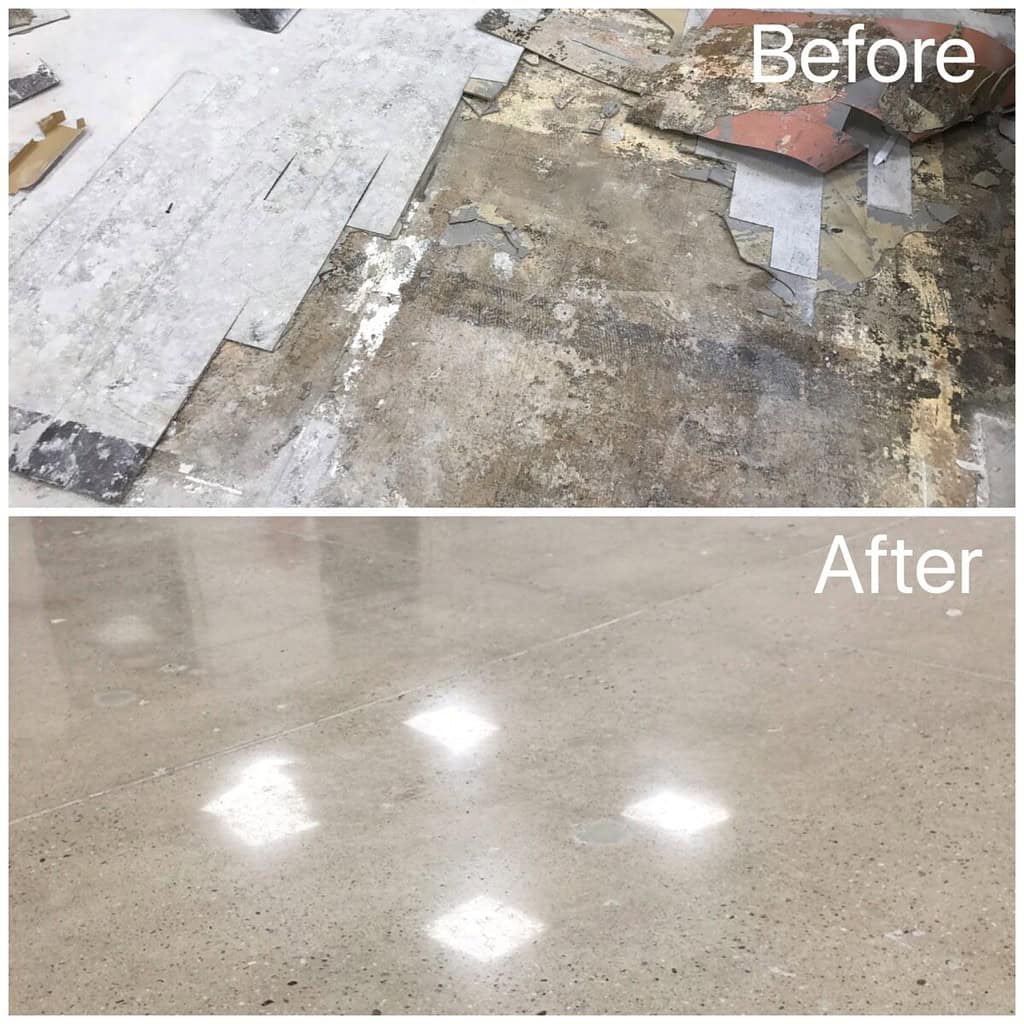
No surface preparation means no mechanical bond. Epoxy doesn't adhere to smooth concrete reliably. Diamond grinding or shot blasting opens the pores and creates the mechanical profile that keeps the coating anchored for years. Without it, the coating sits on top rather than bonding into the surface — and peels at the first opportunity.
DIY vs Professional: The Real Cost Calculation
The appeal of DIY is understandable — big-box stores sell epoxy kits for $150–$400 for a 2-car garage. But the full cost picture looks different:
| Cost Item | DIY | Professional |
|---|---|---|
| Materials (2-car garage) | $150–$400 | Included |
| Etching/grinding tools (rental) | $150–$300/day | Included |
| Moisture testing | Usually skipped | Included |
| Crack repair materials | $50–$150 | Included |
| Your labour time | 1–2 full days | None |
| Warranty | None | 5 years (written) |
| Likely lifespan | 2–5 years (variable) | 10–20+ years |
| Estimated total (2-car garage) | $350–$850 | $1,800–$2,800 |
The DIY upfront cost is lower. But big-box epoxy kits use single-component, water-based or solvent-based products with 40–50% solids. They look good when applied but typically start showing wear and micro-peeling within 2–4 years under vehicle traffic. A professional system installed once for $2,200 and lasting 10–20+ years costs $110–$220/year. The DIY kit re-done every 3 years costs $300–$850 every 3 years — and requires your time and effort each time.
For light-use spaces like a small workshop or storage room, a quality DIY product can work reasonably well. For a garage with daily vehicle use or any commercial application, professional installation is consistently the better 3-year investment.
What a Professional Quote Should Include
Before comparing quotes, make sure you know what's in each one. The line items that matter:
- Surface preparation — specifically diamond grinding or shot blasting (not just acid etching, which is inadequate for most applications)
- Moisture testing — calcium chloride test or RH probe readings
- Moisture vapour barrier primer — specified if testing warrants it, or confirmed as not needed with a reading
- Crack repair — polyurea filler for hairline cracks, epoxy mortar for larger spalled areas
- Broadcast coat — system type (flake, quartz, metallic), broadcast density
- Topcoat(s) — number of coats, product type (polyaspartic, polyurea), gloss level
- Written warranty — duration, coverage, and conditions that void it
A quote missing any of these items is incomplete. Ask specifically: "Does this include moisture testing?" and "What happens if moisture comes back elevated?" The answer tells you a lot about the contractor's experience.
Red Flags That Signal a Bad Deal
The lowest quote is almost never the best value. When three quotes differ significantly, the cheapest one is usually skipping something — prep, moisture testing, an MVB primer, or coat count. Ask what's different.
Frequently Asked Questions
Is epoxy flooring worth the investment in Vancouver?
For most Vancouver homeowners and businesses, yes. The math typically works out when you factor in reduced cleaning time, eliminated dust, moisture protection, and a floor that can last 10–20+ years with proper care. For garages and basements specifically, a well-installed epoxy floor adds measurable resale value and reduces ongoing maintenance costs.
How long does a residential epoxy floor last?
A professionally installed residential epoxy floor with proper surface prep typically lasts 10–20+ years with normal care. Light-use spaces like basements and home gyms are at the higher end of that range. The single biggest factor is surface preparation quality — a floor that's properly diamond-ground and moisture-tested before coating will always outlast one that wasn't.
Does the price include surface preparation?
It should — but not all quotes include it. Always confirm whether the quote includes diamond grinding or shot blasting, crack repair, and moisture testing. A quote that excludes prep looks cheaper upfront but leads to delamination and a costly redo. At Deluxe Coating, all quotes include full surface preparation.
What's the cheapest legitimate option for a garage floor?
A standard flake system on a single-car garage (roughly 200–250 sq ft) typically runs $600–$900 installed. This is the entry-level professional option and is significantly more durable than any DIY kit. Anything quoted below $3/sq ft for a professional installation should be examined carefully — it either skips prep, uses inferior materials, or both.
Can I get a price over the phone?
We can give you a rough ballpark based on square footage and system type. But an accurate quote requires a site visit — we need to assess the concrete condition, test for moisture, identify any cracks or contamination, and measure properly. Any contractor who gives you a firm price over the phone without visiting the site is guessing, and that guess usually doesn't account for the prep your floor actually needs.